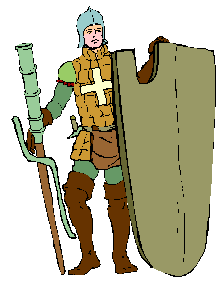
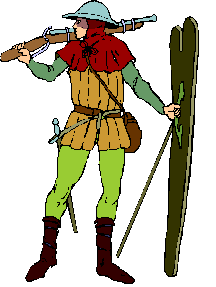
- Many narratives of the famous siege of Orléans (1429) mention the
actions of this gunner. Jean d'Aulon testified [some time after the
event, at the rehabilitation trial of Jeanne d'Arc] that on the first
day of attacking Les Augustins, he instructed the French gunner, Jehan
de Lorraine, to take out "a large Englishman" who was causing great
harm to the French attackers at the gate to the compound. The gunner
succeeded in striking the particular English warrior just before the
French rushed and seized Les Augustins. One author summarizes the
activities on the gunner, Jehan, who was a "phenomenal shot with the
culverin," as follows:
- "The English were already well acquainted with the gunner.
From his post under the pier of a bridge he had inflicted almost as
much damage upon them in his few days at Orleans as all of Gaucourt's
garrison [defenders of the city] in the seven months of the siege. In
spite of their attempts to retaliate, the fellow seemed to lead a
charmed life. He obviously thought so too, for with a grim humor that
was not without its risks he would pretend to be lying dead within full
view of the enemy. Then when he thought they had rejoiced enough, he
would cast gloom upon them by getting up and strutting insolently away,
to repeat his deadly performance on his culverin." [Frances Winwar, The Saint and the Devil, (NY, 1948) p.104. The summary is based upon several contemporary sources.]
Another account of the siege of Orléans (1429) is le Journal du siège d'Orléans
[believed to have been maintained during the event and written by an
observer inside of the city] mentions that on 3 March (1429), "Jean
[Jehan] de Montesiler, originally from Lorraine, a very skilled couleuvriner
... killed in two shots 5 English, of whom [was] Richard, lord of Grey,
nephew to Salisbury." Some authorities note that this "signaled the
advent of this new arm." [André Corvisier, ed. Histoire militaire de la France p.188.]
The killing of more than one
individual with a single shot, suggests a sizable projectile --
possibly a stone ball, no larger than a human fist, but not a small
lead shot. This, in turn, suggests a gun barrel of some caliber
[diameter] -- slightly smaller than a modern infantry-carried mortar.
Such a 'handgun' was probably too large [heavy] for a man to hold and
aim without some assisted support for the gun. But certainly not so
large that it could not be propped on a wall or large shield [pavise, used by crossbowmen]. Such a supported gun is an individual gun -- properly a 'hand-gun' or 'hand-cannon'.
The next question is how well could
the gun be used in a marksman's role -- which is the role ascribed to
Jehan de Montesiler. Could Jehan have performed his feat without a
matchlock? Was it possible to aim an individual's firearm that could
not be raised to the gunner's eye level? Depending on how large the
shot, the required accuracy of aiming may have differed -- smaller shot
requiring more precision.
The specific configuration of Maitre Jehan's gun remains an
issue. Was it hand-held or hand-welded. It is questionable that the
hand-held guns at the time were shoulder supported. Certainly, since
the early fifteenth century there were handguns of very small barrel
diameter and supported by the long wood shaft [stock] braced under the
gunner's arm -- not an ideal position for marksman aiming. A slight
advancement came about sometime in the early fifteenth century when the
wood stock was shortened and braced aside the gunner's upper arm --
possibly even atop his shoulder. This certainly would improve the
aligning of the eye to the gun barrel, and permit better aiming at a
single target. What evidence is there that such a configuration existed
in 1429 Western Europe?
It should be noted that the marksman role was not the incentive
for the early adoption of small firearms. The mass employment of the
early handguns did not require marksman aiming to be effective. A large
number of under-arm supported guns would contribute in disrupting an
enemy's attack in the open, harassing crews operating siege artillery
or workmen reparing damaged fortifications -- the traditional rolls for
crossbow weapons.
If the S- or Z- shaped lever for
aligning the lit match to the powder hole were part of the guns, then
there is a possibility of the gunner being able to point (aim) his
peace with more precision. It should also be noted that a number of
individually operated small guns would be more effective than the same
number of tubes on a single multi-barreled gun in sustained encounters,
as the former could be reloaded more quickly and directed more
effectively toward targets. Of course, it required more gunners. With
missile weapons, rate-of-fire is often more important than mass.
What would cast considerable light on gunner Jehan's ability to
have aimed his piece like a marksman is to know if his gun were
configured with a matchlock. Burt Hall, and a few others who have
examined the evidence of early medieval handguns, agree that one of the
defining features of the first arquebus
[to distinguish it from a short-barreled 16th-century musket that was
also called an 'arquebus'] was the use of a mechanical device to align
the match to the powder-hole. The first such mechanism was a Z-shaped
lever that pivoted at a point along the side of the gunstock. As the
rear end of the lever was squeezed to the stock, the front end lowered
a hot coal or lit match to a touchhole and priming powder near the
breech end of the gun barrel. The earliest evidence of such a device is
an image in a 1411 manuscript now in the Österrichische Nationalbibliothek, Vienna.
The barrel of such guns rested on a
wall, wagon side, a large shield, a pole support. Many of these
hand-directed guns had projections ['hooks'] extending from beneath the
stock of gun barrel. These 'hooked' on to the side of a wall, or wagon
sideboard, and absorbed some of the recoil when the gun was fired.
There are indications that primitative Z- and S- shaped mechanical
locks were significantly introduced by 1430, and were used in the
Hussite Wars (1419-1434) as well as by the gunner at Orléans in 1429.
However, Burt Hall delays dating the effectiveness of these early
'arqubuses' until better [corned] gunpowder became available to propel
the small shot at high velocities, which he suggests is about 1450.
This tracts with the timeframe of recognized French artillery prowess.
[B.S. Hall's Weapons and Warfare in Renaissance Europe (Baltimore, 1997) pp. 96, 119-121, 147-151.]
|